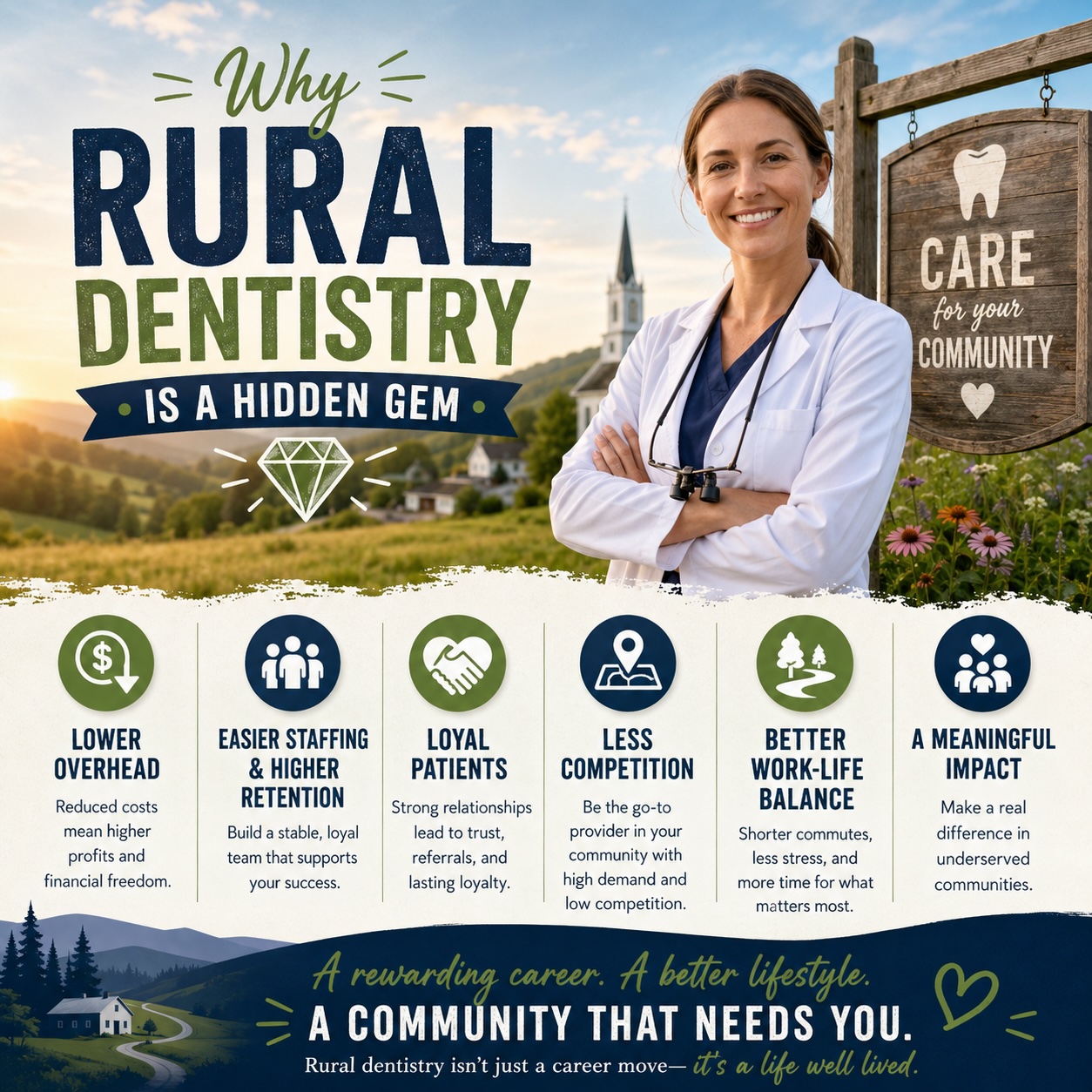
Why Rural Dentistry Is a Hidden Gem
The world of dentistry often conjures images of bustling urban offices packed with cutting-edge technology and a steady stream of patients. Yet while many dental professionals gravitate toward cities in pursuit of prestige or convenience, rural dentistry quietly stands out as an overlooked opportunity in the field. Lower overhead, loyal patient bases, less competition, and a better work-life balance are all real advantages of rural practice — worth a serious look for the right dentist, even if it isn't the right fit for everyone.
A note on where this is coming from: I lead a firm that helps dentists buy, sell, and transition practices, including rural ones, so I have an obvious interest in this conversation. I still think the case below holds up on its own merits.
TL;DR
Rural dentistry tends to offer lower overhead, steadier staffing, loyal patients, less competition, and a better work-life balance than a typical urban practice — trade-offs that suit some dentists far better than others. It's not automatically the easier path (smaller referral networks and a longer drive to specialists are real trade-offs too), but for dentists willing to consider it, rural practice can be a financially sound and personally rewarding move, whether that's a fresh graduate, a mid-career dentist, or someone planning toward retirement.
Lower Overhead: A Financial Consideration Worth Weighing
One of the more immediate benefits of setting up in a rural area is typically lower overhead. In urban centers, real estate prices, rental rates, and operational costs can eat into a dentist's margins before the first patient walks through the door. Rural communities generally have more affordable property values and lower costs of maintaining a practice. That financial breathing room can let rural dentists invest in equipment, hire skilled staff, or keep more of their take-home income — though the trade-off is often a smaller local patient pool and, in some areas, less consumer purchasing power. For new graduates carrying student debt, or established dentists looking to improve margins, it's worth running the numbers for your specific market rather than assuming the rural discount applies everywhere equally.
Easier Staffing and Higher Retention: A Real, but Not Universal, Advantage
Rural dentistry can also make recruiting and retaining a team easier than in cities, where high turnover and competition for skilled hygienists, assistants, and administrative staff can mean near-constant hiring. In smaller communities, a dental practice job is more often seen as a stable, long-term opportunity, and a tight-knit atmosphere can support job satisfaction and loyalty. The trade-off worth knowing about upfront: some rural areas have a genuinely smaller labor pool, so filling a specialized role can take longer even if turnover, once filled, tends to be lower.
Loyal Patients: Building Relationships That Last
In small towns, patients are often neighbors and familiar faces rather than names on a chart. That dynamic can foster a level of patient loyalty that's harder to build in a faster-moving urban practice. Rural patients often value a personal connection with their dentist and the comfort of a consistent care provider. Over time, that can translate into steadier appointment books and more word-of-mouth referrals, though building that trust still takes time — it's not automatic just because the town is small.
Less Competition: Often a Wider-Open Market
Urban dental markets are frequently saturated, with practices competing for patients in a crowded field. Rural areas more often have less competition, and in many small towns, residents already travel some distance to see a dentist — a sign of unmet local demand. This can give rural dentists room to establish themselves as a trusted local option without constant pressure from nearby competitors. Worth checking for any specific market: population trends, provider counts, and how far patients are currently driving for care, since "rural" markets vary quite a bit in how underserved they actually are.
Better Work-Life Balance: A Real Draw for Many Dentists
Rural practice often comes with a slower pace than city life — shorter commutes, quieter surroundings, and fewer of the pressures that contribute to burnout in high-volume urban practices. For dentists with families, that can mean more time at home; for others, more room for hobbies or rest. This is genuinely one of the more consistent advantages dentists report about rural practice, though "slower pace" can also mean fewer amenities and a longer drive for things outside of work — a trade-off worth being honest with yourself about before committing.
A Meaningful Impact: Where You're Often Needed Most
Beyond the practical advantages, many rural areas face real barriers to dental care access, including a shortage of providers and limited transportation options for patients. Practicing in these regions can mean becoming a genuinely important part of a community's access to care, and many rural dentists describe real satisfaction from that role. It's a meaningful consideration, even if it isn't the deciding factor for everyone.
Common Questions About Rural Dentistry
Is rural dentistry a good career choice for new dentists? It can be, particularly for dentists carrying student debt who want lower overhead and faster paths to profitability — though it's worth weighing against a smaller local network of specialists and continuing education resources compared to a city.
Do rural dentists make less money than urban dentists? Not necessarily. Lower overhead and less competition can offset a smaller patient population, and some rural practices post stronger margins than comparable urban ones. It depends heavily on the specific market.
What are the downsides of rural dental practice? Common trade-offs include a smaller local labor pool for hiring, fewer nearby specialists for referrals, longer distances to major cities or amenities, and sometimes a longer runway to build a full patient base in a very small town.
How do I evaluate whether a specific rural practice is a good opportunity? Look at local population and demographic trends, existing provider density, patient drive times to the nearest dentist, and the practice's own financials — rural markets vary enough that generalizations only go so far.
Is rural practice a good fit for dentists nearing retirement? It can be a good fit for dentists who want a slower pace or are considering a gradual transition, such as bringing in a younger associate — though succession planning is worth starting early in a smaller market with fewer potential buyers.
The Bottom Line
If you're a dentist at a crossroads — fresh out of school, considering a mid-career shift, or thinking about a slower pace as retirement nears — rural dentistry is worth a serious look, not as a fallback option but as a deliberate choice with real financial and lifestyle trade-offs in its favor. It isn't the right fit for every dentist or every market, and it's worth evaluating the specifics of a given opportunity rather than assuming the general advantages apply everywhere. For the right person, though, it can be a career that's both financially sound and personally rewarding.
I lead Legacy Practice Transitions Southeast, part of the national Legacy Practice Transitions firm, which reports 30+ years in business and 3,000+ completed practice transitions. I've spent 30 years in clinical dentistry myself, and I work with dentists across NC, SC, GA, and FL on buying, selling, and merging practices — rural included. If you're weighing a move like this, reach out at (843) 290-8584 or rod@legacypracticetransitions.com.